|
Engineering and Renewable Energy
Zero Emission Energy Ad Space Available Through the Renewable Energy Institute Your Ad With Us Will Produce *
New Customers
There's Only
One:
For more information, call/email the Renewable Energy Institute
________________________________________________________________ “spending hundreds and hundreds and hundreds of billions of dollars every year for oil, much of it from the Middle East, is just about the single stupidest thing that modern society could possibly do. It’s very difficult to think of anything more idiotic than that.” - R. James Woolsey, Jr., former Director of the CIA
and the
|
____________________________________________________
Zero Emission
Energy
www.ZeroEmissionEnergy.com
Engineering and Renewable Energy
Project Development Services
What is "Zero Emission Energy"?
"Zero Emission Energy" includes those power plants and power/energy generation technologies that can generate power and energy without any harmful emissions, including;
Several energy and renewable energy technologies generate Zero Emission Power, including;
__________________________________________________
__________________________________________________
About us:
We provide engineering and renewable energy consulting and project development services;
Feasibility Studies
Economic Feasibility Analysis
Front End Engineering Design - FEED
Greenhouse Gas Emissions consulting
Interconnection Studies
Power Purchase Agreement consulting & PPA funding
Project Development
Project Management
Project Finance/Funding introduction to potential investors
Smart Grid
Our work is performed on a strict adherence to "vendor-neutrality" and seek to maximize our client's "triple bottom line" returns: people, planet and profits.
To receive a preliminary, no obligation consult, email us a summary or overview of your project to:
![]()
__________________________________________________
What is the Graz Cycle?
The Graz Cycle is the only thermodynamic combustion cycle that allows for the retention and capture of carbon dioxide emissions from the combustion of fossil fuels.
The Graz Cycle burns fossil fuel along with pure oxygen thereby enabling for the cost-effective separation of the carbon dioxide emissions from the combustion process through condensation. The additional expense for supplying the oxygen for the combustion process - and requirements for an air separation unit, are compensated, in part, through the increase in cycle efficiencies that exceed 65%. The combined efficiency of the Graz Cycle equals of exceeds the thermodynamic performance of other serious contenders in Carbon Capture and Sequestration (CCS).
The Graz Cycle is the thermodynamic cycle that provides for a "zero emission power plant" which also has the highest available efficiencies using gas turbines. The Graz Cycle has also been heralded as a "zero emission" power plant.
In practice, net electrical cycle efficiencies for Graz Cycle power plants have exceeded 65% - which is far higher than typical of state-of-the-art combined cycle plants.
According to the DOE web site, the Graz Cycle consists of a high temperature Brayton cycle and a low temperature Rankine cycle with a Heat Recovery Steam Generator. The Graz Cycle is an oxy-fuel power cycle with the capability of retaining all the combustion generated CO2 for further use. Its cycle configuration aims at highest efficiency by reducing the heat extraction in the condenser to a minimum. A thermodynamic investigation of the Graz Cycle fired with natural gas (CH4) shows a net efficiency of 52.5%, if the efforts for oxygen supply and CO2 compression to liquefaction are considered. If synthesis gas can be used from an external synthesis gas plant at 500°C, efficiencies can rise up to 56%. Studies indicate that further efficiency improvements and simplification of the cycle are possible.
_______________________________________________________
Brayton
Cycle, Cheng
Cycle, Carnot
Cycle, Kalina
Cycle,
Rankine
Cycle and
Waste
Heat Recovery:
the Greenest
of all Renewable
Energy Technologies
What is the Brayton
Cycle?
Gas turbines operate on the principal of the Brayton Cycle, which is defined as a constant pressure cycle, with four basic operations which it accomplishes simultaneously and continuously for an uninterrupted flow of power.
Background
Information and History of Rudolph Diesel and Sadi Carnot:
Rudolph Diesel was educated at the predecessor school to the Technical
University of Munich, Germany. In 1878, he was introduced to the work of Sadi
Carnot, who theorized that an engine could achieve much higher efficiency than
the steam engines of the day. Carnot envisioned a cycle in which a gas is
compressed, heated, allowed to expand, and then cooled. After the gas is cooled,
the cycle begins anew. Mechanical energy is used to compress the gas and thermal
energy to heat it. In turn, expansion of the gas yields mechanical energy, and
its cooling yields thermal energy. The net result is conversion of thermal
energy to mechanical energy.
Diesel sought to apply Carnot’s theory to the internal combustion engine. The efficiency of the Carnot cycle increases with the compression ratio—the ratio of gas volume at full expansion to its volume at full compression. Nicklaus Otto invented an internal combustion engine in 1876 that was the predecessor to the modern gasoline engine. Otto’s engine mixed fuel and air before their introduction to the cylinder, and a flame or spark was used to ignite the fuel-air mixture at the appropriate time. However, air gets hotter as it is compressed, and if the compression ratio is too high, the heat of compression will ignite the fuel prematurely. The low compression ratios needed to prevent premature ignition of the fuel-air mixture limited the efficiency of the Otto engine.
Rudolph Diesel wanted to build an engine with the highest possible compression ratio. He introduced fuel only when combustion was desired and allowed the fuel to ignite on its own in the hot compressed air. Diesel’s engine achieved an efficiency higher than that of the Otto engine and much higher than that of the steam engine. It also eliminated the trouble-prone electric-spark ignition system. Diesel received a patent in 1893 and demonstrated a workable engine in 1897. Today, diesel engines are classified as “compression-ignition” engines, and Otto engines are classified as “spark-ignition” engines.
What is the Carnot
Cycle?
The Carnot Cycle has been described as being the most efficient thermal cycle possible, wherein there is no heat losses, and consisting of four reversible processes, two isothermal and two adiabatic. It has also been described as a cycle of expansion and compression of a reversible heat engine that does work with no loss of heat.
What is the Cheng
Cycle?
The Cheng Cycle is a highly flexible and efficient method of optimizing a cogeneration plant, and more specifically a combined cycle power plant, which also provides a high amount of flexibility in the power and thermal energy output.
For a Cheng Cycle to be implemented, a gas turbine and waste heat boiler or heat recovery steam generator (HRSG) is required. The gas turbine is updated to accept "steam injection" - the steam being "superheated steam" which is capable of handling up to 20% of the exhaust flow from the gas turbine. The saturated steam as well as the superheated steam, is generated from the waste heat boiler or heat recovery steam generator.
When the Cheng Cycle is in 100% power mode, all of the steam that is produced by the "waste heat" from the gas turbine, is "recycled" through the gas turbine. In cogeneration plants, the Cheng Cycle system is set-up so that steam may be used for process application and-or recycled back to the gas turbine. A duct burner is placed between the gas turbine and the waste heat boiler or the heat recovery steam generator (HRSG) which increases the total amount of steam output generated by the plant.
The Cheng Cycle has achieved the following impressive performance metrics on a number of gas turbine generators:
Increases the power output of the gas turbine by as much as 80%
Improves overall efficiency by 40%
With steam injection, can reduce NOx emissions by 90% - achieving 2 PPM
Reduces
CO emissions to less than 10 PPM
What is the Kalina Cycle?
Invented by Alexander Kalina, a Russian engineer, the Kalina Cycle uses a water and ammonia in low temperature Waste Heat Recovery applications, such as geothermal power plants, to increase thermodynamic efficiency and power output.
Problems associated with Kalina Cycle, and why it has never gained significant appeal include;
GE Power attempted to operate a Kalina Cycle power plant in conjunction with a gas fired power plant but found it neither economical or competitive.
Inability to operate efficiently at high temperature or high pressure.
Nitriding of the alloy steel superheater tubes.
Complicated
distillation columns required to recombine the turbine exhaust into the
binary mixture used in the heat exchangers
cycle proposals seem to be based on zero frictional pressure drop and zero temperature differences in the main process components, and it is pretty expensive to meet such requirements.
What is the Organic Rankine Cycle?
A Rankine cycle is a closed circuit steam cycle. (see www.RankineCycle.com for more information).
An
Organic
Rankine Cycle uses a heated chemical instead of steam as found in the
Rankine Cycle.
Chemicals used in the Organic
Rankine Cycle include freon, butane,
propane, ammonia, and the new environmentally-friendly" refrigerants.
Why use a chemical refrigerant?
A refrigerant boils at a temperature below the temperature of frozen ice. Solar
heat, for example, of only 150 degrees Fahrenheit from a typical rooftop solar
hot water heater, will furiously boil a refrigerant. The resulting high-pressure
refrigerant vapor is then piped to an organic Rankine
cycle engine.
Why is it called "organic"?
"Organic" is a term used in chemistry to describe a class of chemicals
that includes Freon and most of the other common refrigerants.
What is the Rankine Cycle?
The Rankine Cycle is a thermodynamic cycle used to generate electricity in many power stations, and is the real-world approach to the Carnot Cycle. Superheated steam is generated in a boiler, and then expanded in a steam turbine. The steam turbine drives a generator, to convert the work into electricity. The remaining steam is then condensed and recycled as feed-water to the boiler. A disadvantage of using the water-steam mixture is that superheated steam has to be used, otherwise the moisture content after expansion might be too high, which would erode the turbine blades.
What is Waste
Heat Recovery?
Many processes, especially in industrial applications, produce large amounts of excess heat – i.e., heat beyond what can be efficiently used in the process. Waste Heat Recovery methods attempt to extract some of the energy as work that otherwise would be wasted.
Typical methods of recovering heat in industrial applications include direct heat recovery to the process itself, recuperators, regenerators, and waste heat boilers. In many applications – especially those with low-temperature waste heat streams, such as automotive applications – the economic benefits of waste heat recovery do not justify the cost of the recovery systems. Innovative, affordable methods that are highly efficient, applicable to low-temperature streams, and/or suitable for use with corrosive or “dirty” wastes could expand the number of viable applications of waste heat recovery, as well as improve the performance of existing applications. Our focus is on the development of innovative Waste Heat Recovery processes and techniques that are (1) more efficient than conventional methods, yet still cost-effective; and (2) applicable to waste streams from which heat cannot be recovered easily with conventional methods.
Turning to cooling, air conditioning systems consume approximately 10% of the energy used in U.S. buildings and are key contributors to peak demand. Consequently, improving the energy efficiency of air conditioning systems would substantially reduce overall energy consumption and enhance grid reliability. For example, compressors require cooling to dissipate the heat produced during compression and could benefit from improved surface heat transfer – innovative designs could increase the available heat-transfer area or materials enhancement could increase the heat flux between the hot and cool sides of a heat exchanger. Similarly, a reduction in the requirement for condenser cooling could provide significant energy savings if more-efficient, cost-effective technologies were developed.
This is where we believe waste heat recovery integrated with our Solar Trigeneration energy systems represents a unique opportunity for commercial and industrial clients.
Industrial Waste Heat Recovery
Waste Heat Recovery from exit gases can significantly increase the energy efficiency of industrial processes. Energy can be recovered from flue and stack gases, vent gases, and combustion gases at a variety of temperatures at large-scale industrial plants (chemical plants, petroleum refineries, biorefineries, pulp and paper mills, etc.).
_______________________________________________________
What is the "Unified Smart Grid"?
The Unified Smart Grid is the name used for the future transmission power lines that would carry green electricity from the many solar power plants and solar power parks and wind farms that generate the power, typically in remote areas, to the "load centers" or major cities that would use the green power.
Quite simply, our country's out-dated and inefficient National Electric Grid, lacks the ability to carry all the new green electricity being planned from hundreds of new solar power parks and wind power generation facilities.
The Unified Smart Grid will be a national interconnected network relying on a high capacity backbone of electric power transmission lines linking all the nation's local electrical networks that have been upgraded to smart grids. Europe's analogous project is sometimes referred to as the SuperSmart Grid, a term that also appears in the literature describing the Unified Smart Grid.
Cost estimates to rebuild the nation's electric grid as a Unified Smart Grid have ranged from $350 billion to $450 billion.
Support for
the unified smart grid came with passage of the Energy Independence and Security Act of
2007. Title 13 of this Act invested $100 million in funding for the
years 2008 – 2012 and establishes a matching program to states, utilities and consumers to build
unified smart grid capabilities. It also creates a Grid Modernization Commission to assess the benefits of demand response
and automated demand response and recommended a set of system protocols and
standards to be led by the National Institute of Standards and Technology which
would coordinate the development of smart grid standards. FERC would then promulgate
these standards and protocols for the unified smart grid through its official
rulemaking capabilities.
The Unified
Smart Grid received further support with the passage of the American Recovery and Reinvestment Act of
2009 that set aside $11 billion for the creation of a smart grid.
Building
a Unified
Smart Grid
would
help jump-start the renewable
energy investments in solar power
parks. Thousands of megawatts of new solar
power parks (both Concentrating
Solar Power plants and Photovoltaic Power Plants) are being planned. Most
are located in the desert Southwest due to the solar energy resource. A Unified
Smart Grid
is
needed to move the large amount of power, which is fairly concentrated, to the
rest of the nation. Without the new Unified
Smart Grid, it
would be impossible to distribute the green power to the nation.
The new Unified Smart Grid is significantly more efficient than the present, nearly 100 year old technology that makes up our nation's present transmission and distribution network of how we get the power from central power plants to customers and major load centers.
Much of the new Unified Smart Grid will be comprised of "High Voltage Direct Current" transmission lines which is significantly more efficient than the present high voltage alternating current transmission lines.
The new Unified Smart Grid will provide economic development, thousands of new jobs, and significantly reduce greenhouse gas emissions.
What
would the new Unified
Smart Grid look like?

Source: American Electric Power
__________________________________________________
For more information on the Unified Smart Grid, visit one of the following sites:
Central Power
Plant
www.CentralPowerPlant.com
Electric Power
Generation
www.ElectricPowerGeneration.net
High
Voltage Direct Current
www.HighVoltageDirectCurrent.com
National
Electric Grid
www.NationalElectricGrid.com
Transmission
and Distribution
www.TransmissionAndDistribution.net
Unified Smart
Grid
www.UnifiedSmartGrid.com
Wind
Power Generation
www.WindPowerGeneration.com
__________________________________________________
You Can't
Have a Unified
Smart Grid Without:
Advanced Metering System * Advanced Meters * Automated Demand Response * Automated Energy Management
Battery Energy Storage * Building Automation Systems * Carbon Free Energy * Clean Power Generation * Cogeneration
Compressed Air Energy Storage * Decentralized Energy * Demand Side Management * Dispersed Generation
Distributed Energy Resources * Distributed Generation * Distributed PV * EcoGeneration * High Voltage Direct Current
Load Leveling * Locational Marginal Pricing * Micro-Grid * Net Zero Energy * Net Zero Energy Buildings
Nodal Pricing * Onsite Power Generation * Pollution Free Power * Plug In Electric Vehicles * Renewable Energy Parks
Rooftop PV * Solar Cogeneration * Solar Power Parks * Trigeneration * Virtual Power Plants * Waste Heat Recovery
_______________________________________________________
What is "Cogeneration"?
Did you know that 10% of our nation's electricity now comes from "cogeneration" plants?
And
because cogeneration
is so efficient, it
saves its customers up to 40% on their energy expenses, and provides even greater savings to our
environment through significant reductions in fuel usage and much lower greenhouse
gas emissions.
Cogeneration
- also known as “combined heat and
power” (CHP), cogen, district energy, total energy, and combined cycle, is the simultaneous production of heat (usually in the form of hot water and/or steam) and power, utilizing one primary
fuel such as natural gas, or a renewable fuel, such as Biomethane,
B100 Biodiesel, or Synthesis
Gas.
Cogeneration technology is not the latest industry buzz-word being touted as the solution to our nation's energy woes. Cogeneration is a proven technology that has been around for over 120 years!
Our nation's first commercial power plant was a cogeneration plant that was designed and built by Thomas Edison in 1882 in New York. Our nation's first commercial power plant was called the "Pearl Street Station."
What is "Trigeneration"?
Trigeneration takes cogeneration one additional step. Trigeneration is defined as the simultaneous production of three forms of energy - typically, Cooling, Heating and Power - from only one fuel input. Put another way, our trigeneration energy systems produce three different types of energy for the price of one. Trigeneration energy systems' overall system efficiencies have exceeded 85% efficiency.
Typical "central" power plants that electric utility companies own and operate normally do not use the heat generated from the combustion and power generation process. Therefore, they are only about 30% to 35% efficient, wasting 65% to 70% of the available energy going in to the central power plant (typically natural gas, diesel/fuel oil or coal) that is simply wasted, and lost, with the heat going up their smokestacks.
Here is a trigeneration diagram that better reflects the trigeneration process:
Trigeneration
Diagram & Description
Trigeneration Power Plants' Have the Highest System Efficiencies and are
About 300 % More Efficient than Typical Central Power Plants
Trigeneration
plants are installed at locations that can benefit from all three forms of
energy. These types of installations that install trigeneration
power
plants are called "onsite power generation" also referred to as
"decentralized energy."
One of our company's principal's first experience with the design and development of a Trigeneration power plant was the trigeneration power plant installation at Rice University in 1987 where our trigeneration development team started out by conducting a "cogeneration" feasibility study. The trigeneration plant's primary power plant was a 4.0 MW gas turbine manufactured by Gas Turbines.
An EPC (Engineering Procurement Construction) company that installed the trigeneration power plant, along with waste heat recovery boilers and absorption chillers.
A "waste heat recovery boiler" captures the heat from the exhaust of the gas turbine. From there, the recovered energy was converted to chilled water - originally from (3) Hitachi absorption chillers - 2 were rated at 1,000 tons each, and the third Hitachi Absorption Chiller was rated at 1,500 tons. However, all three Hitachi absorption chillers were replaced shortly after their installation by the EPC company.
The first trigeneration plant at Rice University was so successful, they added a second 5.0 MW trigeneration plant so today, Rice University is now generating about 9.0 MW of electricity, and also producing the cooling and heating the university needs from the trigeneration plant and circulating the trigeneration power and energy around its campus.

Trigeneration Chart
Trigeneration's
"Super-Efficiency" compared with other
competing power and energy technologies - Trigeneration
energy systems have No Competition!
____________________________________________________
What is a Power Purchase Agreement?
A Power Purchase Agreement is a legal agreement wherein our clients agree to buy either the power (electricity) or the power and energy (hot water, steam and/or chilled water for air-conditioning) - or both - directly from us, for a term of 10 to 20 years, where we have installed, own and operate our solar energy systems.
In
nearly every case, once we have installed our solar
energy systems at our client's facility, we can immediately
reduce our (commercial) client's electricity expenses by 10% over what
they were paying for their power electricity from their electric utility.
The
right Power Purchase Agreement,
solar
cogeneration or solar
trigeneration energy solution, may save your company
hundreds of thousands, and possibly millions of dollars over the term of the
agreement.
Simultaneously, having the wrong or poorly drafted PPA can cost your company thousands or millions of dollars. You wouldn't consult a brain surgeon to treat your child's broken bone! Selecting the wrong attorneys, law firm or team to promulgate or re-negotiate your Power Purchase Agreement can leave you "powerless" and penniless - and still requiring the skills and expertise of competent and qualified professionals to resolve the situation.
Because a Power Purchase Agreement is at the "heart" and underlying foundation of our projects, we can help your business with the selection and oversight of PPA's.
We can help your city or community create a Municipal Utility District or Public Utility District that may then qualify for our very competitively priced energy and electricity rates. Now is the time for cities, municipal and governmental clients to consider having our company install one of our renewable power and energy systems that will generate "clean" power and energy, lower costs, and avoid the coming electricity shortages and grid congestion problems!
Products and services provided by us include the following power and energy project development services:
Project Engineering Feasibility & Economic Analysis Studies
Engineering, Procurement and Construction
Environmental Engineering & Permitting
Project Funding & Financing Options; including Equity Investment, Debt Financing, Lease and Municipal Lease
Shared/Guaranteed Savings Program with No Capital Investment from Qualified Clients
Project Commissioning
3rd Party Ownership and Project Development
Long-term Service Agreements
Operations & Maintenance
Green Tag (Renewable Energy Credit, Carbon Dioxide Credits, Emission Reduction Credits) Brokerage Services; Application and Permitting
____________________________________________________
How To Reduce Greenhouse Gas Emissions
You can easily and affordably reduce or eliminate your company's "carbon footprint" via one or more of our Greenhouse Gas Emissions solutions. Whether you install a an anaerobic digester to generate biomethane, or a biomass gasification plant to generate synthesis gas, a "waste to energy" plant, community wind farm, or one or more solar power parks, we have several renewable energy technologies that can reduce your Greenhouse Gas Emissions, we can provide a tailored solution to your unique situation.
The EPA has targeted oil and gas companies as well as electric utilities, among other industries, to significantly reduce their Greenhouse Gas Emissions. The oil and natural gas industry is in the middle of the EPA "target" for achieving these reductions.
Did you know that Supreme Court ruled in April (2008) that the EPA already has the authority to regulate Greenhouse Gas Emissions? The EPA now requires many oil and natural gas companies to begin "Greenhouse Gas Reporting."
Are you ready for these new regulations? We can help!
According to many sources, “Greenhouse Gas Emissions and Carbon Dioxide Emissions will be the world’s biggest commodity market and will probably soon be the world’s largest market, period."
Every day, leading companies are spending millions of dollars going "GREEN" and reducing their Greenhouse Gas Emissions. The Greenhouse Gas Emissions and Carbon Dioxide Emissions Market Potential is staggering! According to a recent New York Times article, carbon trading is one of the “fastest-growing specialties in financial services.” Already, Greenhouse Gas Emissions Trading and International Carbon Trading markets are worth in excess of $50 billion/year. The United Nations expects this market to be valued in excess of $2 Trillion/year by 2012 and others are saying this could easily exceed $5 Trillion/year within the next several years!
DO THE MATH on the Carbon Dioxide Emissions market!
You may be wondering, how can such a relatively new commodity grow so rapidly? Here in the USA, 40 billion tons of Carbon Dioxide Emissions are produced every year. At the target price of $50 per ton of CO2, the Carbon Dioxide Emissions market is valued at $2.0 Trillion (40 billion tons of Carbon Dioxide Emissions x $50.00/ton).
We can help your company monetize your Greenhouse Gas Emissions reductions.
How to Reduce Your Carbon Footprint
Carbon Emissions, Carbon Dioxide Emissions, and Greenhouse Gas Emissions can be reduced or completely eliminated with renewable energy technologies, such as our Solar Energy Systems - including our super high efficiency Solar Cogeneration and Solar Trigeneration energy systems. Brown buildings can be upgraded in to green buildings and "Net Zero Energy Buildings" through the products and services that we offer.
Qualified commercial, government, industrial and municipal clients can affordably have one of our Solar Cogeneration and Solar Trigeneration energy systems installed, with ZERO up-front costs, with our Power Purchase Agreement. Call/email us to learn more and find out if your business qualifies.
____________________________________________________
Why We Need Renewable Energy & a "Feed In Tariff."
Monty Goodell, MBA, Founder and President of the Renewable Energy Institute, along with the Renewable Energy Institute's Scientific Advisory Board, which is comprised of several of our nation's leading experts, engineers, attorneys, professors and universities, is calling for our nation and all 50 states to adopt a Renewable Portfolio Standard (RPS) of at least 25% by 2025.
And even better than a Renewable Portfolio Standard, according to Mr. Goodell, is a "Feed In Tariff," which is the route Germany took, and why they have had such great success in their transition to a solar based economy. The fastest paths to jump-start the renewable energy industry, is through a "Feed In Tariff.
A Feed In Tariff is superior to a Renewable Portfolio Standard," according to Mr. Goodell. "For example, look at Germany's success in their transition to an economy based on the installation of solar energy systems, they adopted a Feed In Tariff, are further north from the Equator than we are here in the U.S., and they are placing solar panels on every rooftop and wind turbine generators throughout their country. They are leading the world in renewable energy technologies, primarily due to their early adoption of a Feed In Tariff"
What is a Feed In Tariff?
A Feed
In Tariff is a utility rate that is established by a state or federal
government, that requires a utility to pay higher electricity rates for green
electricity generated by the owners of the solar
energy systems, whether that is a homeowner or business owner. Feed
In Tariffs shifts the expenses of subsidizing green energy from taxpayers, to electricity ratepayers.
Feed In Tariffs also include guarantee
that the Feed In Tariffs' artificially
higher rates, will continue for periods as long as 25 years.
Germany's great success for jump-starting the solar energy industry there, first
established Feed In Tariffs in
1999. Germany now has about five times as many
solar photovoltaic panels installed as the United
States - even though their total combined installations of PV panels still
only account for about 0.5% of the electricity generated there.
"So, we go with a Feed In Tariff in lieu of a
Renewable Portfolio Standard.
Simultaneously, we need to start re-building our national
electric grid, and transforming it into 'Transmission
Superhighway' or 'Unified Smart
Grid' and dramatically
increase the nation's power supply as well as implement greater use of 'Energy
Efficiency Measures' - also referred to as Energy
Conservation Measures. And we need to implement "real" 'Demand Side Management' programs. Failure to
move in these areas and to do so immediately increases the risks to our country,
our national security and the climate" according to Mr. Goodell.
According to Mr. Goodell, our nation is at a crossroads and we have been 'over the Middle Eastern barrel of their fossil fuels' long enough. We must shift from energy dependence to energy independence and place significant emphasis and investments in our national energy security and lower greenhouse gas emissions.
Renewable energy, and only renewable energy provides the significant economic and environmental dividends our country now needs. Preferably, our fledgling renewable energy industry in the U.S., will be "jump-started" with a Feed In Tariff.
Some of the economic and environmental dividends that renewable energy will provide our country, include:
Creation of more than 3 million new jobs in the U.S..
Generate more than $1 trillion in economic impacts
Eliminates or Reduces Carbon Emissions and Greenhouse Gas Emissions
Significant reductions of oil imports
Reduce energy prices and save consumers as much as $50 billion on their energy bills
Elimination of billions of pounds of carbon dioxide emissions and other greenhouse gas emissions
Stimulate rural economies
Conserve natural gas supplies
Creates a clean, safe energy future
Position the US as a world leader in renewable energy technologies
According to the Energy Information Administration, the total US primary energy consumption is expected to increase from 100 quadrillion Btu (quads) in 2005 to 131 quads in 2030. However, the renewable electricity generation remains at 9% while use of coal increases 50 percent in 2030 to 57%. Ethanol use is expected to increase from 4 billion gallons in 2005 to 14.6 billion gallons in 2030, yet that is only about 8% of total gasoline consumption.
In January (2008) the National Climatic Data Center (NCDC) blamed the burning of fossil fuels as a key contributor to global warming and accelerating climate change. The NCDC warned that the rate of the warming is accelerating and that the rise in temperatures over the past 9 years is “unprecedented in the historical record." This was underscored in February (2008) in the consensus report by the Intergovernmental Panel on Climate Change that concluded with near certainty that human activity was the main contributor to global warming.
The renewable energy industry, single-handedly, provides a powerful argument and solutions for these problems.
Global warming and climate change are symptoms of a sick planet and the results of unrestrained "dumping" of huge amounts of pollution - in the form of carbon dioxide emissions and greenhouse gas emissions into the atmosphere.
The vast majority of carbon dioxide emissions and greenhouse gas emissions comes from "dirty" fossil fuels (coal, oil, and natural gas) used in making electricity at power plants and dirty fuels (gasoline and petroleum diesel) that run our internal combustion engines in our cars, trains, planes, and trucks. Our planet is home to millions and millions of internal combustion engines that run on dirty fossil fuels - whether they are fueled with gasoline for running our cars and lawnmowers or running on diesel fuel in the engines of trucks and ships like the very large crude carriers that transport the crude oil all around the world...... every internal combustion engine that is running on dirty fossil fuels is dumping millions and millions of tons of carbon dioxide emissions and greenhouse gas emissions into our atmosphere - which is aggravating and exacerbating our sick planet - and making manmade climate change and global warming more difficult to resolve through manmade remedies and solutions.
____________________________________________________
Why
the U.S. Needs A
Unified
Smart Grid
According to Monty Goodell, the Chairman and Founder of the Renewable Energy Institute, "our country desperately needs to upgrade its' national electric grid. The grid of today is a relic from the past, that is inefficient and costly. Originally built in the 1930's, it is costing our nation approximately $120 billion every year due to its' outdated and out-lived existence. The national power grid as designed and built in the 1930's does not have the efficiencies and capabilities to keep pace with the national power grid's demands of today."
"What
we need" according to Mr. Goodell, is a "Unified Smart Grid"
that would be buried underground and "wheels" or transmits
the renewable power ("green electricity") from the wind farms of the
midwest, and solar farms of the southwest, and geothermal farms of the west, to
load centers throughout every corner of the U.S."
According to many estimates, the "Unified
Smart Grid" could be built for about $400 billion. Through its'
increased efficiencies, savings and reliability improvements that it will
provide, the nation's new "unified smart grid" will be paid in full,
in less than 4 years.
____________________________________________________
Greenhouse Gas
Emissions
Linked to
the Loss of Polar Bears
Photo courtesy of Alaska Image Library. U.S. Fish and Wildlife Service
______________________________________________________
What is "
Decentralized Energy"?Decentralized Energy is the opposite of "centralized energy." Decentralized Energy energy generates the power and energy that a residential, commercial or industrial customer needs, onsite. Examples of decentralized energy production are solar energy systems and solar trigeneration energy systems.
Today's electric utility industry was "born" in the 1930's, when fossil fuel prices were cheap, and the cost of wheeling the electricity via transmission power lines, was also cheap. "Central" power plants could be located hundreds of miles from the load centers, or cities, where the electricity was needed. These extreme inefficiencies and cheap fossil fuel prices have added a considerable economic and environmental burden to the consumers and the planet.
Centralized energy is found in the form of electric utility companies that generate power from "central" power plants. Central power plants are highly inefficient, averaging only 33% net system efficiency. This means that the power coming to your home or business - including the line losses and transmission inefficiencies of moving the power - has lost 75% to as much as 80% energy it started with at the "central" power plant. These losses and inefficiencies translate into significantly increased energy expenses by the residential and commercial consumers.
Decentralized Energy is the Best Way to Generate Clean and Green Energy!How we make and distribute electricity is changing!
The electric power generation, transmission and distribution system (the electric "grid") is changing and evolving from the electric grid of the 19th and 20th centuries, which was inefficient, highly-polluting, very expensive and “dumb.”
The "old" way of generating and distributing energy resembles this slide:
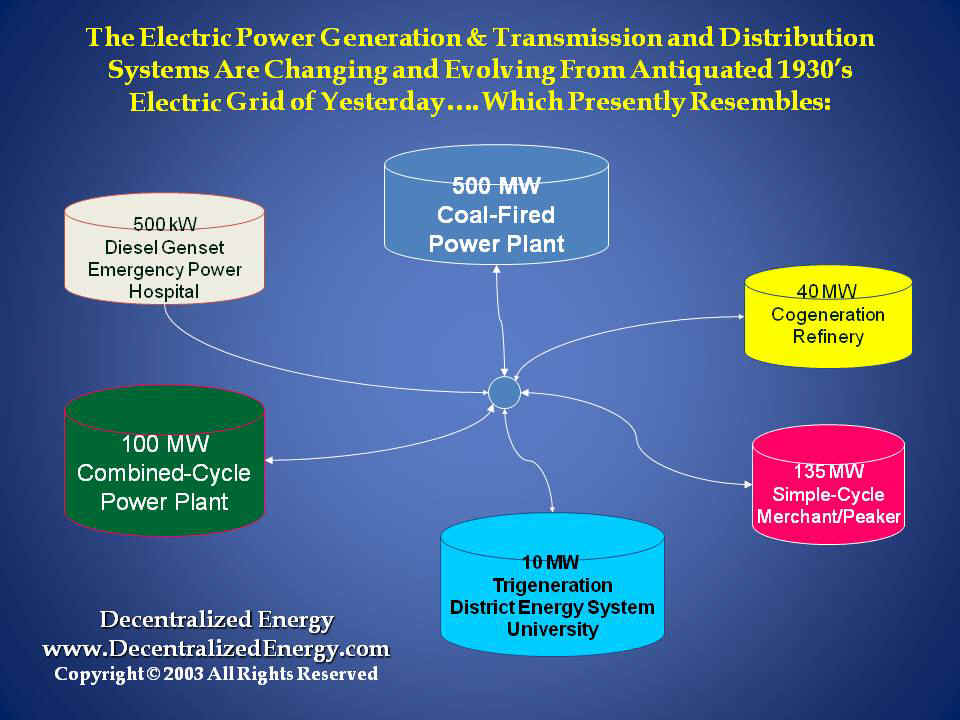
The electric grid of the 21st century (see slide below) will be Decentralized, Smart, Efficient and provide "carbon free energy" and “pollution free power” to customers who remain on the electric grid. The electric grid of the future will be comprised of both Onsite Power Generation plants and "utility scale power plants" that are fueled/powered with Biomass Gasification, Biomethane, Concentrating Solar Power, B100 Biodiesel, Distributed PV, EcoGeneration Systems, Geothermal Power Plants, Synthesis Gas, Rooftop PV, Solar Cogeneration, Solar Energy Systems, Solar Power Parks, Solar Trigeneration and Wind Power Generation - located at Residential, Commercial, Industrial and City/Municipal Locations.
Some customers will choose to dis-connect from the grid entirely. (Electric grid represented by the small light blue circles in the slide below.)
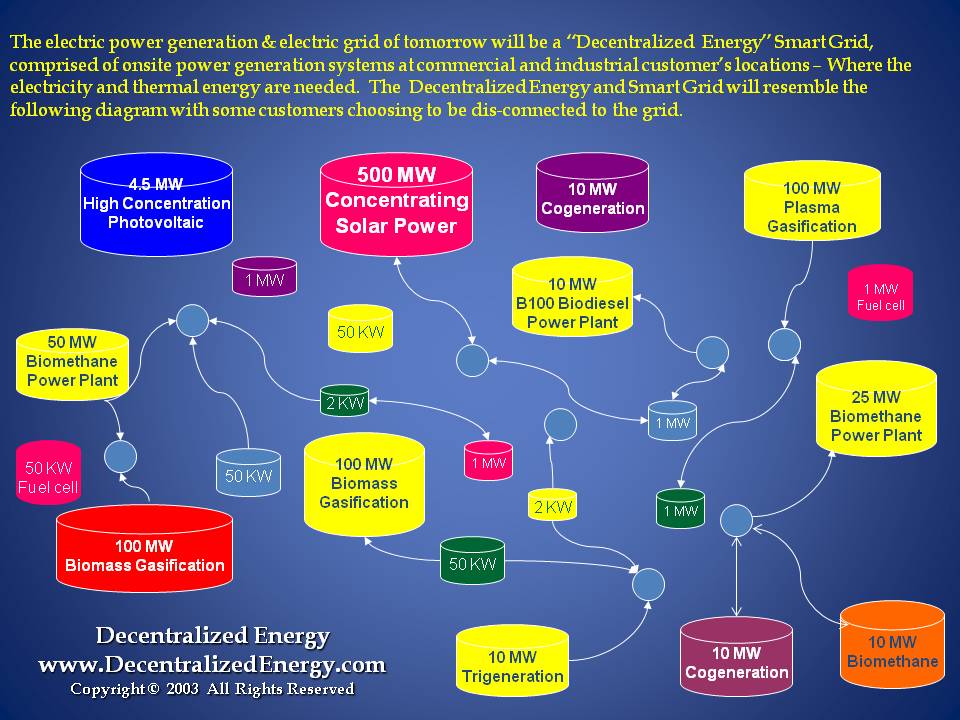
The transmission grid will be upgraded to a "Unified Smart Grid" with green electrons now being wheeled via "High Voltage Direct Current."
Typical "central" power plants and the electric utility companies that own them will either be shut-down, closed or go out of business due to one or more of the following: failed business model, inordinate expenses related to central power plants that are inefficient, excessive pollution/emissions, high costs, continued reliance on the use of fossil fuels to generate energy, and the failure to provide efficient, carbon free energy and pollution free power.
Carbon free energy and pollution free power reduces our dependence on foreign oil and makes us Energy Independent while reducing and eliminating Greenhouse Gas Emissions.
* Some of the above information from the Department of Energy website with permission.
________________________________________________________
America's
"Clear and Present Danger" America
Has INCREASED its' Dependence on Foreign America
is even more "addicted" to foreign oil today, than we were in 1973 -
1974 when OPEC, Saudi Arabia and other suppliers from the Middle-East
stopped selling us their fossil fuels, and created a significant blow to our
economy.
PRODUCES:
7,460,000 bbls of oil CONSUMES:
20,800,000 bbls of oil Simply
put, about 65% of the gasoline in your car's gas tank, comes from a foreign
country. EVERY
day, the U.S. must IMPORT over 13 million bbls of oil from foreign
countries and foreign suppliers to meet demand. This
is NOT acceptable. America
needs to quickly transition to Energy Independence. Renewable
Energy is the Only Way America Can Achieve Energy Independence.
Millions
of new and sustainable American jobs would be created here at home, if we would
end our addiction to foreign fossil fuels, and quickly transition to an economy
based on renewable energy and renewable fuels, produced here in the U.S.A. The good news is that today,
America already has all of the Renewable
Energy Resources and Renewable
Energy Technologies needed to make American Energy Independence a
reality.
According
to Monty Goodell, Founder and Chairman of the Renewable
Energy Institute, "our increased dependence and reliance on foreign
energy supplies represents a Clear
and Present Danger to our national security, our economy, and the lives and
livelihood of every American. Energy - including the energy we use from
imported fossil fuels, is the very "lifeblood" of the American economy
as it is for every industrialized country. An economy dies without it's
lifeblood of energy. This Clear
and Present Danger we face is far more serious than the problems related to greenhouse
gas emissions. And while greenhouse
gas emissions are very serious issue, in the long-term, pales in comparison
to America's vital national security interests and America's economic stability
in the short term. For this reason alone, America needs to transition away
from its addiction to foreign energy supplies. And America's abundant renewable energy
resources such as the energy we receive from the sun, and renewable
energy technologies such as concentrated
solar power (CSP) plants - can supply 100% of America's power
requirements with a concentrating solar
power plant measuring 75 miles by 75 miles, located in the Southwest
U.S. By generating America's power from concentrating
solar power plants, America resolves its' short-term Clear
and Present Danger as it relates to importing its energy from foreign
countries, and the long-term problems relating to greenhouse
gas emissions." Continuing,
Mr. Goodell states that "too many Americans have forgotten what happened to
us in
1973, when the Arabs and OPEC brought the United States economy to a screeching halt
during the OPEC Oil Embargo. This happened because they (mainly the
country of Saudi Arabia)
disagreed with our foreign policy and is the reason why they "turned off the tap" of
our need for their oil supplies. When Saudi Arabia and OPEC
stopped the vital flow of oil to our country in 1973, they caused an "oil shock"
that severely and negatively impacted our economy. Mr.
Goodell's question for us to ponder is, "do these countries who sell us 60%
of our daily energy requirements, like us and our foreign policy, or might they
leverage our addiction to their fossil fuels, and turn off the tap to make us
adjust or revise our foreign policy?? Like any addict, America's foreign
policy may be held hostage to its addiction, and in this case, our addiction to
foreign oil, may over-ride our national interests."
Have
American's forgotten the gas shortages and long lines at "Apparently
so." Mr. Goodell states that "in 1973, America was 'addicted'
and 'over the barrel' of foreign oil to the amount of 40%. Forty percent
of our energy 'needs' in 1973 came from countries - many of which didn't like us
then, and I'm afraid, many of them still don't. The difference between
1973 and today - is that today we receive 50% MORE foreign oil now than we did
in 1973. And now we know about the problems relating to greenhouse
gas emissions that we didn't know then. America needs to change
course, and change course now, in terms of its' energy supplies and how we keep
America's economy strong, without the threat of being held hostage to a
middle-east tyrant or regime, that could once again, turn on us, and turn off
our supply of foreign oil."
Remember
???? "Let
me Repeat.... That
was 1973 when we imported 40% of our daily energy requirements in the form of
crude oil from overseas, and from foreign countries - and many of these from
countries that don't like us. Today,
over 35 years later, America has yet to learn the lesson. We cannot
continue our reliance on energy from foreign countries that supply us with
60% of the crude oil that our refineries use as a feedstock for producing
gasoline and diesel fuel for our cars and trucks comes from overseas. America
is "over the barrel" and it's not our barrel, but the barrels of oil
that we are addicted by and owned by other countries. Why have we not
learned the lessons we needed to learn in 1973 when we were cut-off from the
vital energy supplies we need? Countries
like China, are growing rapidly, and have an insatiable need for crude oil.
China, with their booming economy, is increasingly growing in its clout and
control over international supplies of crude oil - whether they do this through
their ability to buy as much oil as they need on a daily basis, or whether they
simply but American drilling rigs, technology, and explore and produce oil and gas from their own fields. China, is buying large amounts of oil for their country, and causing
upward pricing on declining supplies. What happens if Russia, with all of their
oil and natural gas, along with China and Venezuela, with or without the help of
OPEC, decided to NOT sell oil to us???? To
be sure, greenhouse
gas emissions are a problem, and to some, greenhouse
gas emissions are also a Clear
and Present Danger, but not to the extent that it presents an imminent Clear
and Present Danger. America's
reliance for 60% of our energy "needs" coming from foreign suppliers
is un-acceptable. The
"driver" to get America to begin reducing and eliminating fossil fuel
use should be our nation's national security and the welfare and safety of its
citizens. And this can all begin with developing and investing in our own renewable energy
resources and renewable
energy technologies, let's start by putting solar on every rooftop that has
a clear and unobstructed view of the Southern sky. See www.RooftopPV.com
or www.DistributedPV.com
for more information. Let's create incentives begin with adopting a
national "Feed In Tariff" as
Germany did in 1990. We simply do NOT have the luxury of time on our hands. We need to end our
dependence and reliance on foreign fossil fuels, especially from countries that
don't like us! We need to rapidly begin expanding renewable energy
resources and renewable
energy technologies from our vast and abundant renewable energy resources,
such as; solar, solar energy
systems, solar cogeneration,
solar trigeneration,
"solar on every roof," along with; Biomass
Gasification, B100 Biodiesel, Biomethane,
E100
Ethanol (from cellulosic, agricultural waste, sugar cane, etc., and NOT from
corn), Geothermal Power Plants,
Natural Wastewater Treatment,
Synthesis Gas, Waste
To Energy, Waste To Fuel and Wind
Power Generation where it makes economic and environmental sense."
For more information, call/email the
Sources of Energy by 50% Since 1973.
According
to the CIA Fact Book, Every Day, the U.S.
This
Means that 65% of America's Energy Supplies are Now Imported from Suppliers
from Foreign Countries.
At
$80/barrel of oil, this also means that $1,040,000,000.00 American Dollars leave
our country, EVERY DAY, to foreign countries/suppliers of our fossil fuels, to
pay for the energy we need.
That's
$1 Billion EVERY day leaving our economy, and going to support a foreign
country's economy.
Talk
about our foreign trade deficit..... nearly $400 Billion each year, leaves our
country to pay for our oil addiction and the energy we need. To be exact,
that's $379,600,000,000.00 American Dollars.
their gas stations to get
gas during the Arab Oil Embargo of 1973?

"Sadly,
most Americans have forgotten the long lines of people waiting in their cars
- lined up and waiting
for gasoline at their nearby gas station, with lines that were many blocks
long. And, after waiting 4-5 hours, many even waiting overnight in many places, to
finally take their turn to fill up their car with gasoline, only to find that
the gas station
had run out of gas."
Renewable Energy Institute![]()
____________________________________________________
Are you doing your part to prevent Climate Change and End America's Reliance on Foreign Energy?
Our following
EcoGeneration
technologies,
including our
Biomethane,
B100
Biodiesel and
Synthesis Gas Fuels
Generated from our "Waste to Fuel"
technologies are Carbon Free Energy
and Pollution Free Power
solutions that will:
* forever change the way energy is generated and used.
* eliminate or greatly reduce our customer's electric demand charges and electric expenses.
* slow, stop and eventually reverse climate change by reducing and then
eliminating anthropogenic
greenhouse
gas emissions
- of which
carbon
dioxide emissions
makes up 80% of all greenhouse
gas emissions.
* reduce and eventually eliminate the use of coal and other fossil fuels.
*
reduce the need for inefficient and expensive central power plants owned by
utility companies.
* promote energy independence.
* end America's dependence on oil from OPEC and other countries in the Middle-East, Venezuela and end our need for importing natural gas from Russia.
American
Energy Plan
www.AmericanEnergyPlan.com
Anaerobic Digester
www.AnaerobicDigester.com
Anaerobic Digesters
www.AnaerobicDigesters.com
B100 Biodiesel
www.B100Biodiesel.com
Battery
Energy Storage
www.BatteryEnergyStorage.com
Biomass
Gasification
www.BiomassGasification.com
Biomethane
www.Biomethane.com
Building Automation System
www.BuildingAutomationSystem.com
Carbon
Dioxide Emissions
www.CarbonDioxideEmissions.com
Carbon Emissions
www.CarbonEmissions.com
Carbon Free Energy
www.CarbonFreeEnergy.com
Clean Power Generation
www.CleanPowerGeneration.com
Cogeneration
www.Cogeneration.net
Concentrating
Solar Power
www.ConcentratingSolarPower.com
Demand
Response Programs
www.DemandResponsePrograms.com
Distributed
PV
www.DistributedPV.com
Distributed
Solar Generation
www.DistributedSolarGeneration.com
EcoGeneration
www.EcoGeneration.com
Greenhouse Gas Emissions
www.GreenhouseGasEmissions.com
Net
Zero Energy
www.NetZeroEnergy.com
Net
Zero Energy Building
www.NetZeroEnergyBuilding.com
No Foreign Oil
www.NoForeignOil.com
Plug
In Electric Vehicles
www.PlugInElectricVehicles.com
Pollution
Free Power
www.PollutionFreePower.com
Rooftop
PV
www.RooftopPV.com
Solar Energy Systems
www.SolarEnergySystems.net
Solar Power Parks
www.SolarPowerParks.com
Solar Cogeneration
www.SolarCogeneration.com
Solar Trigeneration
www.SolarTrigeneration.com
Synthesis Gas
www.SynthesisGas.com
Trigeneration
www.Trigeneration.com
Waste Heat Recovery
www.WasteHeatRecovery.com
Waste to Energy
www.WasteToEnergy.net
Waste
To Fuel
www.WasteToFuel.com
Wind
Power Generation
www.WindPowerGeneration.com
Zero Emission Energy
www.ZeroEmissionEnergy.com
Zero Emission Power
www.ZeroEmissionPower.com
______________________________________________________
We support the Renewable Energy Institute by donating a portion of our profits to the Renewable Energy Institute in their efforts to reduce fossil fuel use through renewable energy and their goals to end fossil fuel pollution by reducing/eliminating Carbon Emissions, Carbon Dioxide Emissions and Greenhouse Gas Emissions.
The Renewable Energy Institute is "Changing The Way The World Makes and Uses Energy by Providing Research & Development, Funding and Resources That Creates Sustainable Energy via 'Carbon Free Energy,' 'Clean Power Generation' and 'Pollution Free Power' Through Expanding the use of Renewable Energy Technologies."

![]()
![]()
www.RenewableEnergyInstitute.org
Email: info(@)Renewable Energy Institute (.)org
The information contained on this site is
copyright protected and
cannot be
reproduced in any form or manner without our consent.
Zero Emission Energy
www.ZeroEmissionEnergy.com
Renewable Energy
Institute
Copyright
© 2003
All Rights Reserved